
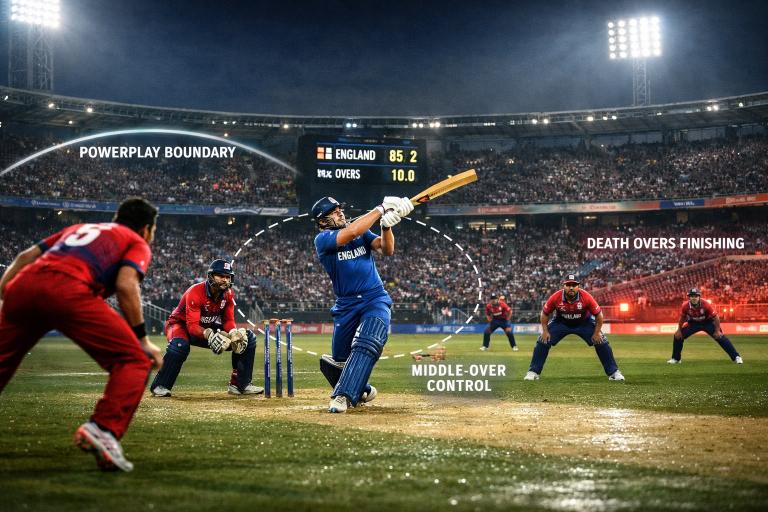
England vs Nepal is more than a T20 World Cup fixture — it’s a collision of cricketing philosophies on one of India’s most batting-friendly stages. England arrive as a polished, role-driven T20 machine built on tactical discipline and execution clarity. Nepal step in with fearless intent, momentum cricket, and the ambition to unsettle established systems.
T20 matches at venues like Wankhede rarely hinge on reputation. They are decided by phase control, matchup awareness, and pressure handling. This preview delivers a full tactical breakdown — from team frameworks and pitch dynamics to fantasy logic and probabilistic prediction — designed for readers who want insight, not surface narratives.
Tournament Context — Why This Game Matters
Opening fixtures shape tournament rhythm. A strong start influences net run rate, squad confidence, and tactical continuity.
England’s position
England’s white-ball system emphasizes:
- Defined batting roles
- Matchup-driven bowling rotation
- Controlled powerplay aggression
- Middle overs tempo management
This reduces volatility — a crucial asset in short tournaments. A win allows strategic flexibility in later matches.
Nepal’s objective
For Nepal, this contest is about credibility and momentum:
- Testing batting resilience against elite pace
- Establishing spin pressure
- Building psychological confidence
A competitive showing reinforces belief and tactical discipline moving forward.
Wankhede Pitch Report — Tactical Impact
Wankhede Stadium is a high-scoring environment that actively shapes match behavior.
Surface traits
- True bounce and carry
- Fast outfield
- Minimal seam deviation
These conditions reward vertical bat swing, boundary targeting, and early scoring intent.
Spin influence
Spin acts as a tempo breaker rather than a dominant force. Wrist spin becomes effective when batters overcommit to aerial hitting.
Dew factor
Evening dew reduces grip, impacting slower balls and spin control. Bowling units must adapt seam position and variation timing.
Strategic takeaway: Teams that dominate the powerplay often dictate match tempo.
Team Identity — Tactical Frameworks
England: structured aggression
England’s T20 blueprint is built on role clarity and controlled acceleration.
Powerplay: Attack pace, expand the field, build scoring cushion
Middle overs: Anchor + aggressor pairing maintains tempo
Death overs: Predefined finishing patterns maximize boundary output
Bowling focuses on phase specialization, pace variation, and run containment.
Read More -
New Zealand vs Afghanistan Match Prediction: Fantasy Tips, Pitch Analysis & Key Battles
Nepal: controlled disruption
Nepal thrive on momentum shifts and spin pressure.
Powerplay batting: High-risk acceleration
Middle overs: Dot-ball squeeze through spin
Bowling: Variation timing designed to induce mistakes
Their success hinges on destabilizing batting rhythm.
Phase-by-Phase Match Simulation
Powerplay (Overs 1–6)
England target: 55–65
Nepal target: 45–50
Momentum ownership is critical.
Middle overs (7–15)
England rotate strike to neutralize spin.
Nepal aim for scoring stagnation and risk induction.
This phase is the tactical hinge.
Death overs (16–20)
England possess structured finishing depth.
Nepal must execute yorkers and variation discipline.
Margins are often decided here.
Tactical Matchups to Watch
- England hitters vs Nepal spin pressure
- Nepal top order vs England pace bounce
- Fielding pressure and boundary denial
Execution discipline outweighs raw hitting.
Psychological Layer
England carry tournament composure and scenario clarity. Nepal bring fearless energy and underdog freedom. Momentum swings — wickets or boundary bursts — can rapidly alter match tone.
Fantasy Cricket Strategy
Fantasy success depends on phase involvement.
Safe core picks
- England top-order batters
- Lead spinner
- Death overs bowler
High-ceiling options
- Aggressive opener
- Wrist spinner
- Finishing all-rounder
Captaincy priority: multi-phase contributors
Vice-captain: top-order impact player
Small leagues reward stability; grand leagues reward calculated volatility.
Data-Based Prediction Model
Key evaluation factors:
- Batting depth
- Bowling discipline
- Venue compatibility
- Tactical adaptability
Projected totals:
England batting first: 175–195
Nepal batting first: 145–165
Chasing difficulty increases above 180.
Win probability estimate:
England — ~75%
Nepal — ~25%, conditional on early breakthroughs.
Match Prediction
England’s structured batting depth and phase clarity provide a measurable advantage, particularly in high-scoring conditions. Nepal’s path to victory requires early wickets and middle-overs spin dominance.
Prediction: England favored to win — likely by 20–35 runs or 5–7 wickets, depending on match flow. However, momentum shifts could tighten the contest if Nepal control overs 7–15.
FAQs
Who has the tactical edge?
England, due to structural depth and finishing depth.
Can Nepal upset England?
Yes — if spin pressure disrupts middle overs rhythm.
Is Wankhede high scoring?
Yes, true bounce favors aggressive strokeplay.
Which phase decides the match?
Middle overs tempo control.
Best fantasy approach?
Stable core + one calculated high-upside pick.
Conclusion — Intelligence Over Reputation
England vs Nepal is a study in T20 structure versus disruption. Wankhede’s batting canvas amplifies both execution quality and decision-making errors.
England rely on disciplined acceleration. Nepal depend on fearless momentum swings. The side that controls middle overs tempo likely dictates the result.
For analysts, fantasy players, and serious fans, this contest reinforces a core T20 principle:
Matches are won through phase control, role clarity, and pressure management — not reputation alone.
Expect tactical adjustments, intensity, and moments where small decisions shape the scoreboard.



Comments (42)
Great analysis! I think the toss will be crucial. If India bats first and puts up 300+, it's game over for NZ.
Don't underestimate the Black Caps! We've won in India before. Williamson's leadership will make the difference.